Tech
Pushing
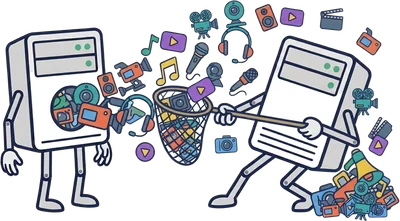
Pushing is the reverse of pulling. With pulling, the Media Server takes a stream from somewhere else. With pushing, it sends a stream it already has somewhere else.
Here too the Media Server is the one who starts. You tell it over the REST API which stream to send and where, and the server pushes it to another server or a service, such as YouTube or Twitch.
The stream can come from anywhere: published from a browser, an app or an encoder, or pulled from a camera or a file.
WebRTC
The Media Server can push a stream to another WCS server over WebRTC. One REST API call, /push/webrtc/startup, gives it the other server's address, such as wss://wcs.example.com:8443/websocket, the name of the local stream and the name to publish it under there.
The server connects to the other one and publishes the stream to it over WebRTC. Video goes as H.264 or VP8, audio as Opus, with the low latency of WebRTC all the way.
This is how a stream published in one place reaches viewers connected to another server, for example in another region.
RTMP
RTMP takes a stream to live streaming services: YouTube, Twitch, Facebook, Telegram, and to other media servers such as Wowza, AWS MediaLive or Azure Media Services. A stream published from a browser over WebRTC goes out as RTMP, with no encoder on the publisher side.

rtmp://live.example.com/app/stream-keyThe REST API call /push/rtmp/startup takes the name of the stream and the service's RTMP URL with the stream key, for example rtmp://live.example.com/app/stream-key. RTMPS works too, for services that accept only it, and a server that asks for a login gets the name and password in the URL. Video goes as H.264, audio as AAC, G.711 or Speex.
One stream can be pushed to several services at once, a call for each.
Launch your streaming server
LLcast will deploy a dedicated Media Server just for you. Publish or pull a stream once, and push it wherever it needs to go: to another server over WebRTC and to YouTube, Twitch and Facebook over RTMP.